Killing My First Server (And Why I’m Glad I Did)
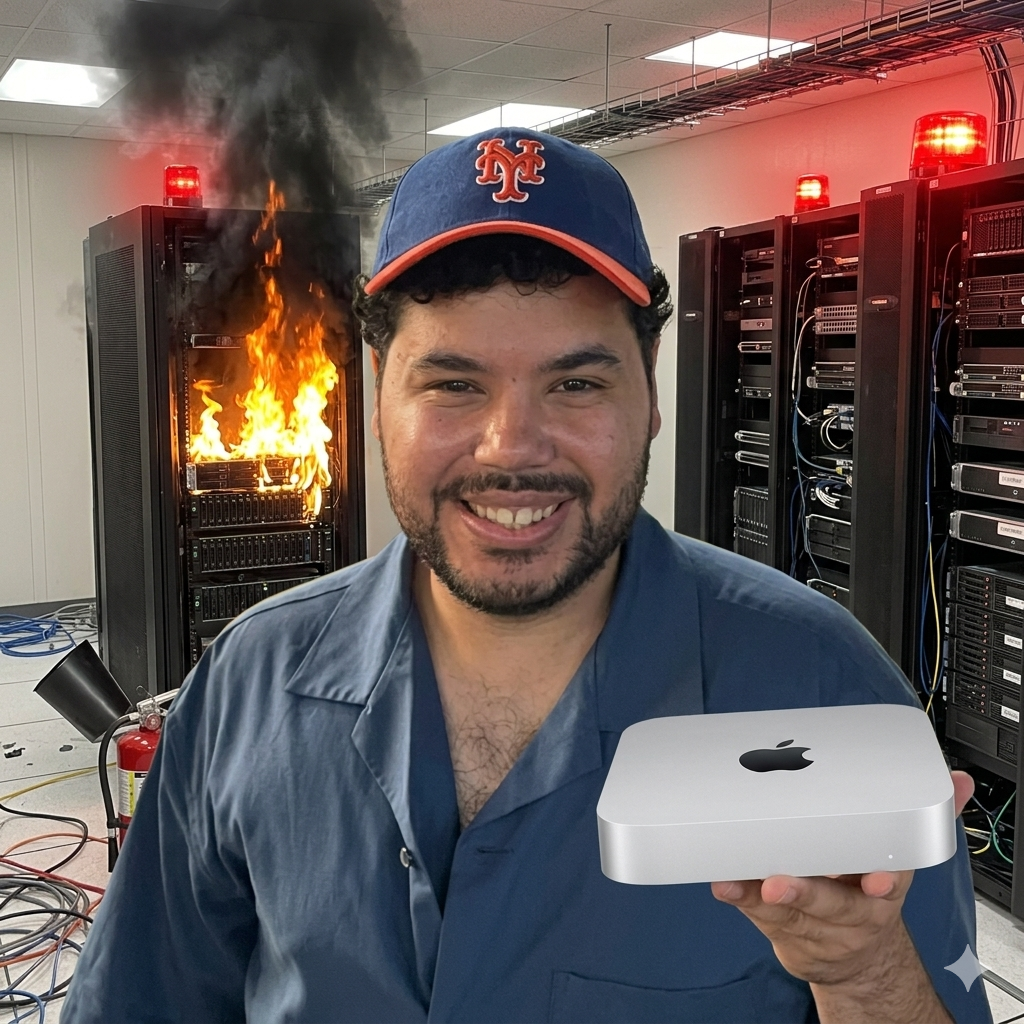
This isn’t my first home server—it’s actually my second attempt.
My first one lived inside an old gaming PC I built years ago. I repurposed it into a Debian-based server, mostly for media. It wasn’t elegant, and it definitely wasn’t efficient, but it worked. With loud fans, high power draw, and oversized hardware for simple tasks, it had all the classic signs of a “first homelab.”
But it was mine. More importantly, it taught me a lot.
The Breaking Point
Then one day, it just… stopped being reliable. The fan in the desktop went bad, and with it came heat, instability, and the slow realization that this setup wasn’t built to last. I could’ve replaced the fan or maybe upgraded a few parts, but instead, I took it as a sign to start over.
The New Foundation: The 2018 Mac Mini
Not long after, I inherited a 2018 Mac Mini for free. On paper, the specs are modest—an Intel i3 with 8GB of RAM—but in practice, this machine punches far above its weight.
However, getting Ubuntu Server installed on it wasn't a "plug-and-play" experience. Because of Apple's T2 Security Chip, I hit an immediate wall of friction:
- Boot Restrictions: Navigating the recovery menu just to allow external booting.
- Specialized Kernels: Hunting down the
t2linuxkernel so the SSD and internal hardware would actually be recognized. - Trial and Error: Break something, research, retry, repeat.
Eventually, it clicked. Compared to my old setup, the Mac Mini is efficient, quiet, and incredibly reliable. It now runs all my services through Docker and acts as the true backbone of my homelab. Despite the "entry-level" specs, it handles everything I throw at it without breaking a sweat.
Comparison: The Evolution
| Feature | The Old Guard (Gaming PC) | The New Standard (2018 Mac Mini) |
|---|---|---|
| CPU/RAM | i5 6500k, RX 480 | Intel i3 / 8GB RAM |
| OS | Debian | Ubuntu Server (T2-Linux)(Still Debian essentially) |
| Form Factor | ATX Mid-Tower (Huge) | Small Form Factor (Sleek) |
| Acoustics | Jet Engine | Silent |
| Efficiency | High Power Draw / High Heat | Minimalist & Cool |
Lesson Learned
If there’s one thing this experience taught me, it’s this: Your first setup doesn’t have to be perfect—it just has to get you started. That old Debian server wasn’t pretty, and it didn’t last forever, but it gave me the foundation I needed to build something better the second time around.
Every mistake, every failure, and every “why isn’t this working” moment compounds into experience. And honestly, that’s what this whole journey is about.